
Note to the Reader
If you have ever wondered why your brain feels different after illness, why you cannot focus the way you used to, or why the phrase “new normal” makes you want to roll your eyes and cry at the same time, this story is for you, especially if you have been feeling broken after illness and cannot quite explain why.
This is not medical advice. It is a mirror.
This story is about stroke recovery, brain fog, cognitive changes, and the quiet grief that shows up when your old operating system is gone, but nobody hands you instructions for the updated version.
Instead of pushing through it, read it like you are reading a book. Take what helps. Leave what does not.
A Prescription Called Broken
A story about brain fog, a new normal after illness, and the lie that says you’re broken.
She said it casually, like she was talking about the weather.
“I lost my IQ.”
Her eyes dropped, and the truth arrived before the sentence could soften. This was not about intelligence. It was about what happens when your mind feels different after illness and you do not have language for it yet.
Alice tried to explain it in practical terms. Her brain sometimes acted like it needed tech support for things that used to be simple and automatic. Planning. Scheduling. A calendar screen that suddenly looked like a puzzle designed by someone who hates you. The kind of executive function stuff nobody thinks about until it gets hard.
“No, I need tech support,” she corrected herself with a quick laugh. “My husband handles that.”
After that, she told me about her stroke a few years ago. The damage. The long months of rehab. How her words got stuck. How her body had to be trained back into motion one slow step at a time. It took forever to feel functional in the world again.
And then she said it quieter.
“I’m dumb now.”
She followed it with another small laugh, like she was trying to outrun her own grief. Then she gave me an example, because examples make things feel official. Scheduling an event on a calendar could confuse her. Her mind would turn to fog, she would stare at the screen, and suddenly she felt foolish. She offered it like evidence, like the final proof that the verdict had been earned.
The Verdict Voice
As she talked, I found myself stunned for a different reason. The woman in front of me was charming, funny, charismatic, and still sharp in a way you could feel. She was present and engaged, warm in her timing, quick with details. She was fully here. But she was describing someone else, a version of herself from before, someone I had never met.
Her words landed in my body. The terrain she was describing felt familiar, and there was no judgment in me, only recognition. So I asked what helps and what has gotten easier since the early days. Then I let her speak her truth as she knows it today, without trying to fix her in real time.
What she was naming sounded like grief. In me, it triggered shame. Same moment, two different currents. And I could feel both at once, hers in the open, mine under the surface.
Not because Alice used that word. She did not. She was naming real losses and real effort, the daily rerouting and the exhaustion of living in a system that now had different settings. The shame was mine. It was the old reflex that turns change into a verdict and starts subtracting your worth the moment you cannot function the way you used to.
A dozen responses tried to rise in me, and all of them sounded like help. But I also know what it feels like when someone tries to yank your pain away before you are ready to put it down. So I stayed with her, listened, and let her be exactly where she was.
The File That Reopened
Later, the conversation replayed in my mind like a movie I did not buy a ticket for. One sentence kept repeating.
I lost my IQ. I’m dumb now.
That night, her words followed me home like my nervous system had been handed a memo it couldn’t unread. I knew that terrain, because I have lived my own version of it.
Because after my heart attack, I did not just recover physically. I lost my old operating system. Everything recalibrated: body, mind, energy, even my tolerance for stress. My ability to be “on” all the time got revoked without my consent, which is an extremely rude way for life to behave.
For years, honestly more than a decade, I tried to get back to who I was. Back to fast. Back to capable. Back to the Joy who could handle everything and still smile and still be “fine.” And every time I could not get there, I used it as proof that I had lost something essential. Intelligence. Value. Worth. The ability to be the person I thought I had to be in order to be lovable in this world.
It was an old story for me, the one that sits quietly in the corner since childhood, waiting for an opening. I cost too much. I don’t bring enough. I’m not worth the trouble. So when Alice said what she said, I did not just hear her. I heard myself.

The Box on the Mat
Later that night it was dark and cold out. The air had that heavy winter feeling, like everything was holding its breath until spring. I opened my front door and there it was, a plain package sitting on my welcome mat. No logo. No sender. No postage. No cheerful tape with messages like “smile” or “you’ve got this.” Just a neat cardboard box, packaged all nicely, with my name printed clearly on the label.
Spelled correctly, which is either a miracle or a threat. I still have not decided.
I stood there staring at it like it might start talking, and something in me knew this was not really mail. This was a message. I brought it inside and set it on the kitchen table, and then I did what I do with things that might change me.
I avoided it.
I walked past it like it was a normal box. I checked my phone. I found chores to do like I was auditioning for the role of “person who is totally not nervous.” Because sometimes we do not open the gifts because we do not want what they confirm. Sometimes the gift is not comfort. Sometimes the gift is a new life, and a new life means the old plan is not coming back.
We say we want healing, but what we often want is restoration. We want the same life, the same self, the same rhythm, just without the pain part. Life does not do refunds. It does change. It does upgrades. It delivers inconvenient truth in plain packaging.
The box stayed on the table for days. Every time I walked by it, my mind tried to talk me out of it. It’s probably nothing. It’s probably useless. It’s probably proof you are not who you were. That harsh narrator is never creative. It just repeats itself with different props.
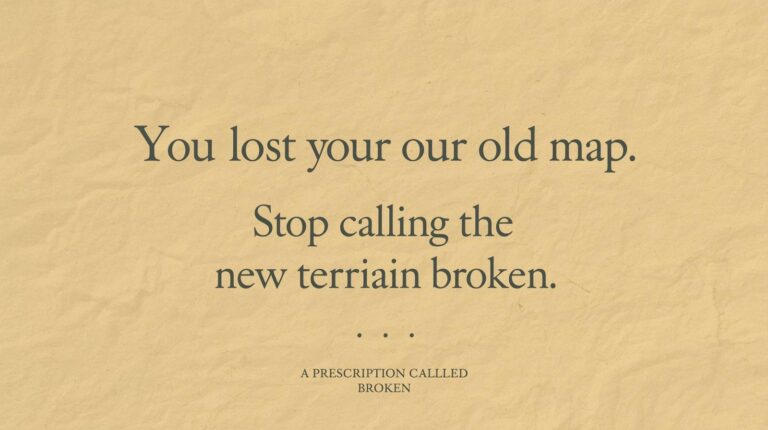
The Prescription
One night I opened a drawer looking for scissors and my hand landed on an old pair of glasses I had not worn in years. Scratched lenses. Bent frame. The glasses from the era when I was still trying to prove I was fine. I put them on without thinking.
And the kitchen looked worse.
Harsh light. An unfriendly room. Sharp edges everywhere. Even my own hands looked less capable, less good, less enough. It was subtle, but it was real. So I took the glasses off and laughed, because apparently the universe has jokes.
I had been wearing a prescription called broken, not on my face but in my story. I had been seeing myself through scratched glass and calling it truth.
Then I looked over at the box on the table and finally gave in. “Fine,” I said out loud, the way you negotiate with a stubborn toddler. Except the toddler was my fear. So I sat down, pulled the box toward me, and opened it.
Inside was not a miracle. No dramatic music. No angel choir. No glitter. It was quiet, practical, almost annoyingly simple.
There was a folded piece of paper and a small cloth, like the kind you use to clean lenses. Beneath wrapped in tissue paper, were a few ordinary-looking items: a small mirror, a key, a sticky note pad, and a pen that felt heavier than it should.
I unfolded the paper. It said:
You did not lose intelligence. You lost your old map.
Stop calling the new terrain broken.
New gifts do not arrive labeled. Your mind will label them for you if you do not.
Adaptation is intelligence.
Gentleness is strength.
Asking for help is leadership.
For a moment, I just sat there. Not because it was poetic, but because it was true. Then I picked up the mirror and looked at my face, not before, not after, just me. Alive. Human. Not a project.
Next, I picked up the key and turned it over in my hand. I did not know what it opened, but I knew what it meant. There are doors you cannot enter as your old self. You need a new key.
The sticky note pad made me laugh out loud. Of course. One thing at a time. Like a human.
And the pen felt like choice, like ownership, like permission to stop rehearsing my old story and start writing a new one.
Then I cried. Not the pretty kind. The kind that comes when you realize how long you have been fighting yourself. The kind that says, I am tired. I am done trying to earn my own worth back.
The Sticky Note
I thought of Alice. I thought of how she said dumb like it was final, and I understood something that softened me all the way down. When people say, “I am broken,” they are often naming grief. They are grieving the loss of the old operating system. They are grieving the version of themselves who could do life the old way.
Even so, the new version arrives quietly. It takes time to trust. It rarely comes with a label.
The next time I saw Alice, she told me again about the calendar confusion and did that small embarrassed laugh. And I did not correct her. I did not argue with her lived experience or try to pry her story out of her hands like I had some kind of right to it. Instead, I did something smaller.
I pulled out a sticky note and wrote one appointment on it. One. Simple. Clear. Then I said, “Would it help if we do it this way for now?”
Her shoulders dropped just a little, like her body had been bracing for judgment and did not get it. So I said, gently, because words matter, “I do not think you are dumb. I think you are learning a different way to be brilliant.”
She looked at me like she wanted to believe it, but did not know how yet. So I did not push. I let the sentence sit there, available if she wanted it.
Clean the Lens
That night, back in my own kitchen, I opened the drawer again and looked at those scratched glasses. For years I had tried to use them to make sense of myself. They did not help me see. They helped me judge. So I put them away, not with anger and not with rejection, just like you put away something you do not need anymore.
Then I set the lens cloth on the table where I could see it, a small reminder to clean the way I see and clean the way I speak about myself. Because if I do not, that harsh narrator will gladly do it for me.
And it will not be gentle.
Closing Reflection for You
If you came here searching for a new way to think about recovery, start here.
You are not broken. You are whole, and you are learning what your new whole looks like, especially if you have been feeling broken after illness and quietly wondering what happened to the person you used to be.
Take a breath. You can answer these in your head, or write them down if that feels supportive.
Have I been dealing with brain fog, memory changes, or trouble concentrating after illness, and quietly wondering if I am losing myself?
Is there a task that makes me feel embarrassed lately, planning, remembering, organizing, following a calendar, staying focused?
When that happens, what do I tell myself?
What is the sentence I repeat when I am tired?
If I wrote that sentence down and set it in front of me, would I call it truth, or would I recognize it as fear trying to sound factual?
What would be a more accurate sentence, even if it is small and unglamorous?
What would it look like to stop trying to go back and instead support the version of me that is here?
If I did one thing today, just one, not to prove I am okay, but to care for my nervous system and my mind the way I would care for someone I love, what would it be?
Write it down if you can. Or say it to yourself once, gently.
One note. One appointment. One next step.
Not as proof.
As kindness.
The Invitation
If this story resonated with you, I have a feeling you have your own version of that moment when your body stopped operating the way it used to and your mind tried to call it broken.
If you want to share, I would love to hear it. What has your transition looked like, and what has helped you find your way through it?
Leave a comment, or send me a message. Tell me what you are learning, what you are choosing, and what stillness is starting to teach you.